%20copy.png)


Building Supplier Governance That Actually Gets Used
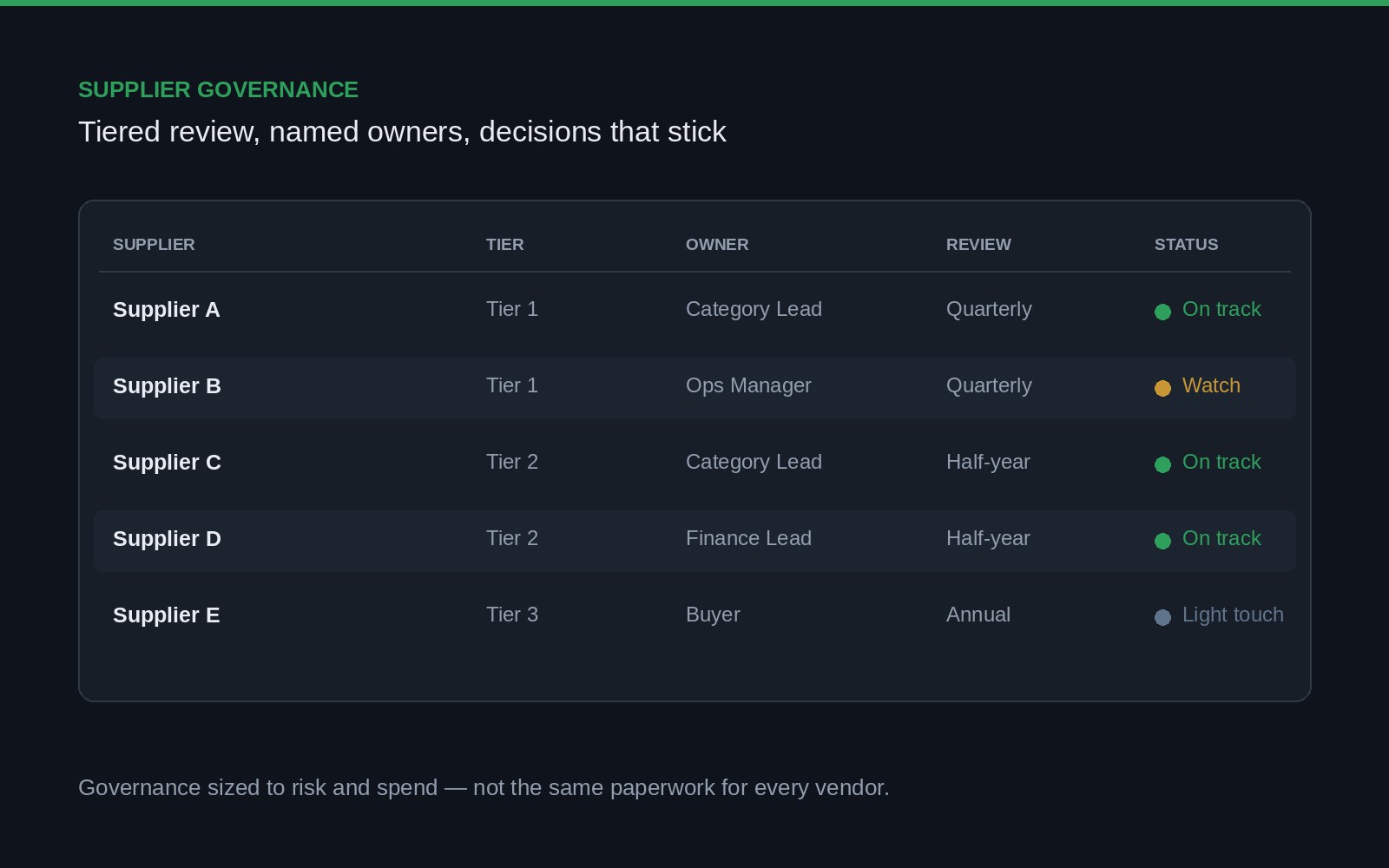
Most companies already have some version of supplier governance on paper: a tiering model, a scorecard template, maybe a calendar of business reviews. The gap is usually not in the framework itself, it's in whether anyone actually follows it once the initial rollout enthusiasm fades.
Governance that gets used tends to share a few traits. It's tiered by actual risk and spend, not applied uniformly, so a handful of critical suppliers get real attention while low-risk, low-spend suppliers get a lighter process rather than the same paperwork. It has a named business owner for each supplier relationship, not just a procurement contact, so accountability doesn't disappear between review cycles. And the review cadence is matched to what the relationship can support: quarterly business reviews make sense for a handful of strategic suppliers, not for the full vendor list.
The other common failure is a scorecard that measures what's easy instead of what matters. On-time delivery and invoice accuracy are simple to track, but if the metrics never connect to a decision, like whether a supplier gets more business, gets put on a corrective action plan, or gets replaced, the scorecard becomes an exercise nobody takes seriously. A governance program only stays credible if it's visibly tied to real consequences.
The right-sized version of this, especially for smaller organizations, is simpler than most templates suggest: identify the handful of suppliers whose failure would actually hurt the business, assign a clear owner to each one, meet on a cadence the team can sustain, and make sure the conversation leads somewhere. That's the version of supplier governance MPM Strategic Group builds with clients, sized to what the organization can realistically keep running.

Discover similar content and expand your knowledge.

What's Changing in Procurement Operating Models
Procurement is shifting from transactional buying to a center-led operating model built on spend visibility, segmented supplier management, and broader commercial skill sets.

Contingent Workforce Programs: What to Get Right
A practical look at contingent workforce programs: the real difference between an MSP and a VMS, and the classification, rate-card, and offboarding details that are worth getting right from the start.


.png)